
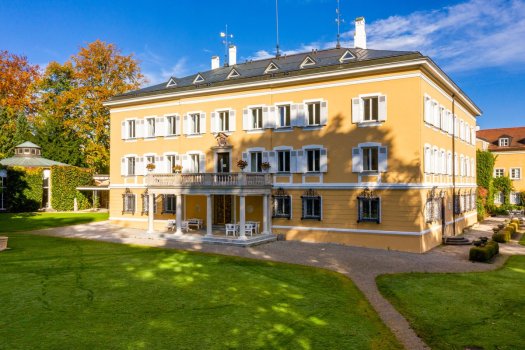
Venue: Evangelische Akademie Tutzing
Program
Sunday 22nd of September
17:00
Arrival from 17h
Dinner is not included!
20:00
Welcome
20:30
Poster Session 1 & Drinks
Monday 23rd of September
08:00
Breakfast
09:00
Morning Session:
Roland Pfister: Ideomotor Action Control
In this session we will explore current research on how human agents control their action repertoire. A simple but powerful approach to this question is the ideomotor principle. We will use this framework to assess how flexibly agents can switch between different action representations, and how they accommodate different types of action effects within their action repertoire. Corresponding findings further inform theorizing on body representations by highlighting a surprisingly flexible updating of the body-related representations. We will specifically address one such case in terms of recent research on disembodiment, i.e., the removal of previously embodied entities from the body representation.
10:30
11:00
12:30
14:00
Coffee break
Resume Session
Lunch
Afternoon Session:
Matej Hoffmann & Marianne Jover and Valentin Marcel, Filipe Gama, Jason Khoury & Sergiu Popescu ‘Tools connecting the infant’s movements to the development of an active self’
The first part of the session will focus on the benefits of analyzing young infants’ movements to understand their perception of their social and physical surroundings and the constraints this implies in a naturalistic context (Jover and Gratier, 2023). Some aspects of movement that may be useful in understanding the development of Active Self will be presented: position (self-touch, orientation), speed (movement units, overall activity), acceleration (jerk), frequency (rhythmic activity), etc. (e.g., Di Mercurio et al., 2019; Khoury et al. 2022).
In the second part, we will outline some of the options of recording infants’ movements (single or multiple video (RGB) cameras, depth cameras (RGB-D), and marker-based motion capture) and how suited they are for extracting infants’ motions. We will then present software that can be used to manually annotate or automatically extract infant poses and motions. We will focus on automatic extraction of 2D pose (Gama et al. 2022) and 3D pose (Hesse et al. 2018) and comparison between frame-by-frame manual coding of motor activities and automatic identification).
After the break, a practical session will be organized in small groups to examine different possibilities on provided sample videos of infants or videos brought by the participants.
15:30
16:00
18:00
20:30
Coffee Break
Resume session
Dinner
Poster Session 2 & Drinks
Tuesday 24th of September
08:00
09:00
Breakfast
Morning Session
Kai Vogeley: Concepts of the self from an interdisciplinary perspective
The workshop will address theoretical and empirical approaches to the self, ranging from the concepts of a so-called ‘minimal self’ to an ‘extended self’ and an ‘interpersonal self’. The minimal self encompasses the experiences of ‘I-here-now’ (‘moi-ici-maintenant’), which represent a basic sense of subjectivity at a given moment in time. The components of the minimal self can be operationalised as agency, including body ownership (‘I’), perspective taking in space (‘here’) and the experience of presence (‘now’). The integration of these time slices of the minimal self results in an ‘extended self’ or ‘autobiographical self’ which further requires the experience of transtemporal unity or diachronicity. Finally, in communication with others, we differentiate and oscillate between ‘I’ and ‘me’, which constitutes an ‘interpersonal self’. The workshop will present these different concepts of self from a theoretical point of view and discuss a number of empirical indicators (perspective taking in space, agency, temporal experience, social interaction) from the perspective of cognitive psychology and cognitive neuroscience.
10:30
11:00
12:30
14:00
18:00
Coffee break
Resume Session
Lunch
Walk/Beergarden
Dinner
Games night
Wednesday 25th of September
08:00
09:00
Breakfast
Morning Session:
Dr. Anna Ciaunica ‘Hybrid Embodied Agency in Human – AI Interactions’
For most of us, most of the time, our experiences seem to be tacitly accompanied by a sense of self – a sense of being an embodied agent within a world, among but distinct from others (Gallagher 2000). Everyday experience also seems to involve experiences of agency; namely, the feeling that I am in control of my own bodily actions, that I can leverage them to access and change the external world’ (Gallagher 2000; Haggard 2017). It is now well established that humans attribute human-like states to artificial others. However, the effect of interacting with artificial minds and bodies on the human sense of agency is less understood. In this talk we will present theoretical and empirical work looking at embodied joint agency in human/ human versus human/ robotic and virtual agents. Specifically, we will outline the key role of the human embodiment and sense of self in establishing joint agency with artificial others. We will argue that in order to establish a “sense of we” with both humans and artificial agents, humans need to feel connected to their own bodies first. We introduce the notion of ‘hybrid agency’ to describe these new, technologically mediated ways to embody and control in tandem human and artificial minds and bodies in real and virtual environments. Do we develop a sense of hybrid “we” in interacting with these artificial agents? If yes, in which sense this sense of “we” is different from the sense of togetherness that we have when we interact with biological systems? We will discuss key implications of these questions on recent efforts to design autonomous and interactive artificial others.
10:30
11:00
12:30
Coffee break
Resume Session
Lunch
Followed by the Symposium
 DFG SPP "The Active Self"