
Half-day workshop as part of the IEEE International Conference on Robot & Human Interactive Communication (RO-MAN 2025)
August 29th, 2025 / Eindhoven, Netherlands
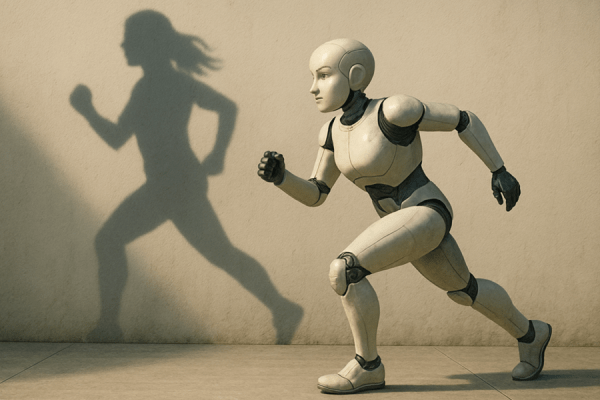
The Turing Test has long served as a benchmark for evaluating artificial intelligence based on verbal communication. Yet, in real-world settings, intelligence is not expressed through language alone. With robots increasingly operating in dynamic human environments, the ability to recognize, interpret, and generate non-verbal behavior becomes equally important. This workshop centers on the idea that movement can serve as a valid and meaningful domain for assessing human-likeness and intelligence in robots.
This workshop explores how the Turing Test can be extended beyond verbal interaction to assess artificial agents based on physical behavior and movement. Specifically, it focuses on how non-verbal behaviors, such as navigation, approach strategies, and gesture, contribute to perceptions of human-likeness, intentionality, and adaptivity in robots operating within social environments.
The workshop examines both theoretical and applied aspects of extending the Turing Test to robot movement. Drawing on insights from human-robot interaction, robotics, neuroscience, and psychology, we address key questions such as: Which movement characteristics lead to the attribution of agency in robots? How can subtle behavioral cues be systematically measured and interpreted as indicators of intelligence? And what kinds of evaluation frameworks are needed to assess non-verbal social competence across different interaction contexts?
Through this interdisciplinary discussion, we seek to define a foundation for evaluating robotic movement as a meaningful signal of machine intelligence and social capability.
List of Topics
- Turing Test in Robotics
- Impact of Robotic Movement on Human Perceptions of Safety, Comfort, and Collaboration
- Extensions of the Turing Test to Non-Verbal Robotic Behaviors
- Evaluating “Human-Likeness” in Robotic Movements
- Movement Patterns in Social and Task-Oriented Interactions
- Developing Metrics for Naturalness and Adaptability in Robotic Behavior
- Computational Models of Motor Behavior with Implementation and Validation in Robot Platforms
- Adaptive Movement Strategies for Robots in Human-Interactive Environments
- Cross-Cultural Perspectives on Interpreting Robotic Movement Behaviors
 DFG SPP "The Active Self"