
Movement Matters – A Turing Test for Robot Interaction
Name: Kristina Nikolovska
Affiliation: Constructor University
Website: https://www.linkedin.com/in/kristinanikolovska/
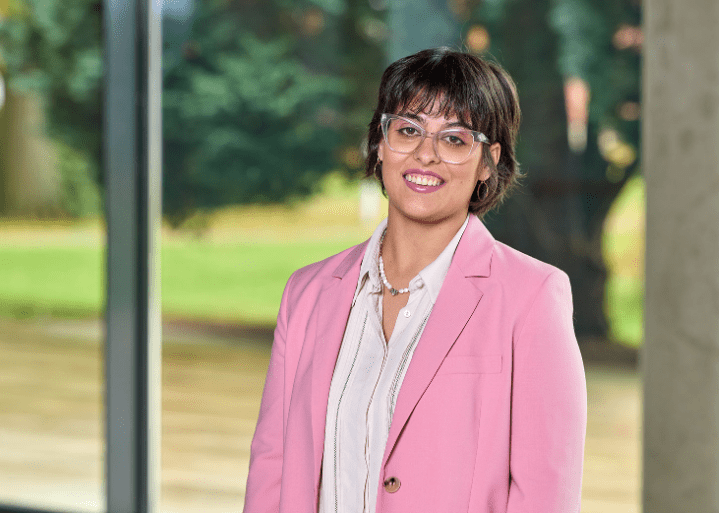
Kristina Nikolovska is a PhD student in the Computer Science and Electrical Engineering department at Constructor University Bremen. She holds a Master of Engineering degree and specializes in robotics, focusing on robot control, human-robot interaction (HRI), motion planning, and adaptive robot behaviors. Her research explores how robots can exhibit human-like movement and how people perceive agency and self-attribution in artificial agents.
Name: Jan Pohl

Affiliation: Dresden University of Technology
Website: http://jan-pohl.cog-sci.eu
Short Bio: Jan Pohl is a PhD student at Dresden University of Technology at the Faculty of Psychology. He holds a Master of Science in Cognitive Science and currently investigates how humans perceive robot behavior and start to attribute more abstract concepts like selfhood or sociality.
Name: Anna Lena Lange

Affiliation: Humboldt-Universität zu Berlin, Germany
Website: https://www.scienceofintelligence.de/people/anna-lange/
Short Bio: Anna Lange is a PhD student in the Computer Science department at Humboldt-Universität zu Berlin. She holds a Master of Science in Computational Neuroscience and specializes in robotics, focusing on adaptive learning, human-robot interaction, and neural networks. Her research explores how robots can learn and adapt their behaviors in social interactions based on human psychology principles.
Name: Dr. Doris Pischedda
Affiliation: University of Pavia
Website: https://sites.google.com/view/dorispischedda/home
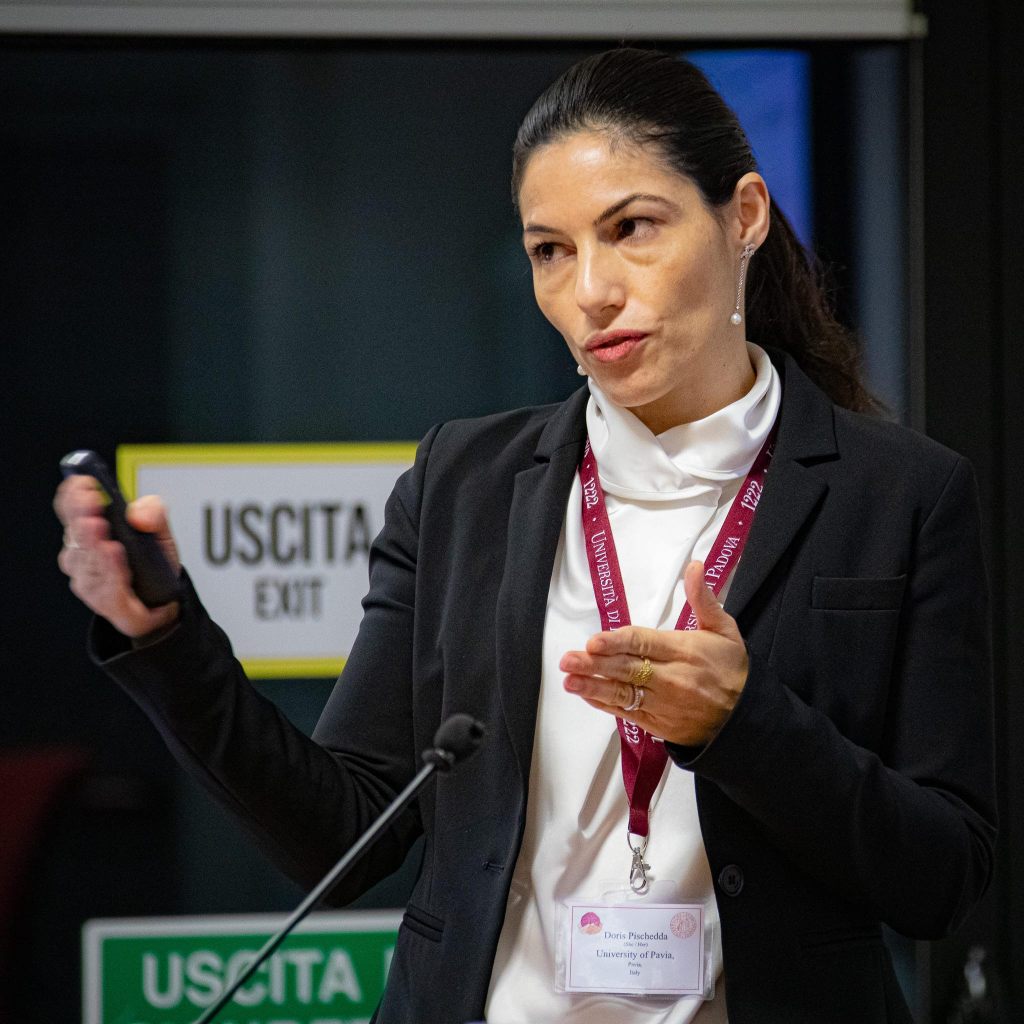
Short Bio: Doris Pischedda is Assistant Professor at the Department of Brain and Behavioural Sciences of the University of Pavia. She has investigated cognitive mechanisms underlying social interaction and their neural correlates in both human-human and human-robot interaction. She employs a combination of behavioral paradigms, (f)MRI, and computational modeling to build biologically inspired neural models that are able to simulate brain dynamics. These models not only provide insights into brain dynamics at different scales (allowing for reproducing more realistic and adaptive robotic behavior) but also permit scientists to derive hypotheses that can be tested using artificial systems.
Name: Dr. Dimosthenis Kontogiorgos

Affiliation: MIT
Website: https://www.csail.mit.edu/person/dimosthenis-kontogiorgos
Short Bio: Dimosthenis Kontogiorgos is a Postdoctoral Researcher at MIT CSAIL, and his research explores how to develop explainable multimodal AI technologies for collaborative interactive robots. He has co-organised the Robo-Identity series of workshops at HRI 2021-2024, as well as workshops for Interspeech 2017, SigDial 2019, ICMI 2020, and CUI 2023. He has also been involved in the organizing committee of ICMI 2024 and AC editorial roles for ROMAN 2024, ACII 2024, CHI 2025, RA-L, and THRI.
Name: Prof. Francesco Maurelli

Affiliation: Constructor University
Website: https://constructor.university/faculty-member/prof-dr-francesco-maurelli
Short Bio: Dr. Francesco Maurelli is a Professor in Robotics at Constructor University, in Bremen (Germany, EU), where he also serves as Program Chair for the Robotics and Intelligent Systems Program. He has obtained his PhD at Heriot-Watt University (Edinburgh, Scotland) with a thesis on intelligent robot localisation. Dr. Maurelli’s research interests are focused on persistent autonomy for robotics, perception, autonomous navigation, intelligent decision making, sensor data processing and fault management.
Name: Prof. Verena V. Hafner

Affiliation: Humboldt-Universität zu Berlin, Germany
Website: https://adapt.informatik.hu-berlin.de/vvh/
Short Bio: Verena Hafner is Professor of Adaptive Systems at Humboldt-Universität zu Berlin and Head of the Adaptive Systems Group at the Department of Computer Science. She focuses on sensorimotor interaction and development. She has investigated open-ended development and social interaction in artificial agents that attracted high interest in the cognitive and developmental robotics community and she has substantial experience in interdisciplinary cooperation. She is part of the Programme Committee of the DFG Priority Programme The Active Self (SPP 2134), PI in the DFG Cluster of Excellence “Science of Intelligence”, and PI in the EU Horizon EIC project METATOOL. Her research interests include sensorimotor interaction and learning, joint attention, internal models, exploration strategies and the artificial self.
 DFG SPP "The Active Self"